Vietnam is positioning itself as the next technology hub in Southeast Asia. Supporting this potential, the Vietnamese government is advancing a plan to grow the country’s digital technology enterprises to about 100,000, providing jobs for over three million professionals in the industry.
This creates significant opportunities for aspiring professionals to build careers in the technology sector. However, as organisations increasingly adopt AI-powered technologies, the demand for talent extends beyond technical expertise alone. Employers are looking for professionals who can combine strong technical foundations, business acumen, collaboration skills, and AI fluency to drive real-world outcomes.
To help bridge this gap, MaivenPoint’s Tech Talent Training Programme in Vietnam equips emerging professionals with the skills, experience, and industry exposure needed to succeed in today’s workplace. Through intensive training programmes, hands-on projects, mentorship, and direct access to enterprise environments, the initiative has supported dozens of aspiring technology professionals and continues to expand its talent pipeline.
Creating Pathways Into Technology Careers
Since launching the programme, MaivenPoint has focused on one goal: helping promising talent transition from classroom learning to real-world careers.
Working closely with the Vietnam National University in Ho Chi Minh City (VNU-HCM) network, MaivenPoint actively connects with fresh graduates and young professionals seeking to transition into technology careers. Through this collaboration, the programme helps bridge the gap between academic learning, career exploration, and the skills needed to succeed in enterprise technology roles.
The first cohort welcomed 36 participants into an intensive professional development journey designed to prepare participants for enterprise technology roles. Following the completion of the programme, 29 graduates joined the Ho Chi Minh City office of AvePoint, MaivenPoint’s parent company. These recently hired participants now contribute to customer projects, product development initiatives, and digital transformation initiatives.
Building on that success, the Tech Talent Programme expanded to a second cohort of 41 participants. Together, these cohorts represent MaivenPoint’s continued investment in developing Vietnam’s next generation of technology professionals.
Building Next-Generation Professionals with Specialised Tech Talent Tracks
Recognising that successful digital transformation depends on both technical expertise and business leadership, the Tech Talent Training Programme offers specialised development pathways:
Quality Assurance Engineers
As organisations accelerate software delivery and adopt AI-powered development practices, quality assurance is evolving from a traditional testing function into a strategic discipline focused on quality engineering, automation, and continuous improvement.
Recognising the growing demand for skilled quality professionals, the Tech Talent Training Programme recently introduced a dedicated quality assurance engineer pathway. This track provides participants with the technical, analytical, and collaborative skills needed to help organisations deliver secure, reliable, and high-quality digital experiences.
The quality assurance track focuses on:
1. Quality engineering fundamentals. Learn software testing methodologies, test planning and execution, defect management, quality standards, and risk-based testing approaches.
2. Automation and modern testing practices. Gain hands-on experience with test automation, quality checks, and emerging AI-assisted testing tools.
3. Communication and collaboration. Develop skills in defect reporting, stakeholder communication, root cause analysis, and cross-functional collaboration with developers, product teams, and business stakeholders.
4. Real-life agile project experience. Apply testing and quality engineering practices in sprint-based projects, participate in agile ceremonies, and contribute to delivering production-ready solutions in real-world scenarios.
AI-Ready Software Engineers
As AI reshapes the software development landscape, technical talent must be prepared not only to build applications but also to work effectively with AI-powered tools and technologies.
The tech talent launchpad’s software developer track focuses on four core learning pillars:
1. Software engineering fundamentals. Strengthen software engineering fundamentals, including full-stack programming, database design, infrastructure and security, and solution architecture.
2. AI skills and modern development. Gain exposure to prompt engineering, AI-assisted coding, application development using large language models (LLMs), and responsible AI adoption practices.
3. Communication and professionalism. Learn technical documentation, stakeholder communication, cross-group collaboration, and presentation techniques that are essential in modern global teams.
4. Real-life agile project management. Work in sprint-based teams, participate in daily stand-ups, collaborate across functions, and build project portfolios that demonstrate their capabilities in practical settings.
Business Project Managers
Technology transformation also requires professionals who can manage complexity, align stakeholders, and deliver business outcomes.
To support this need, the Tech Talent Training Programme also incorporates a business project management development pathway, which focuses on five core learning pillars:
1. Business analysis fundamentals. Build foundational business analysis skills, including requirements elicitation and analysis, process modelling and documentation, stakeholder analysis and management, and business case development.
2. Project management fundamentals. Learn project lifecycle methodologies, project planning and tracking, as well as scope, time, cost, quality, risk, issue, and change management practices that support successful project delivery.
3. AI skills for project delivery. Gain hands-on experience using AI tools to support research and analysis, automate project documentation tasks, generate business insights, improve decision-making, and enhance productivity through prompt engineering techniques.
4. Communication and professionalism. Strengthen stakeholder communication, presentation and storytelling skills, business writing practices, and professional collaboration capabilities that are essential for leading cross-functional initiatives.
5. Real-life agile project management. Apply their learning in an end-to-end agile project experience, working in sprint-based teams, collaborating across functions, participating in agile ceremonies, and delivering final project outcomes that demonstrate their capabilities in a practical business environment.
Immersing Talent in Collaborative Workspaces
This tech talent launchpad is supported by a workplace environment designed to help professionals continue developing beyond their initial training.
At the Ho Chi Minh City office, team members have opportunities to collaborate with experienced mentors, work on enterprise-grade projects, and contribute to initiatives that span software engineering, project management, AI innovation, and digital transformation.
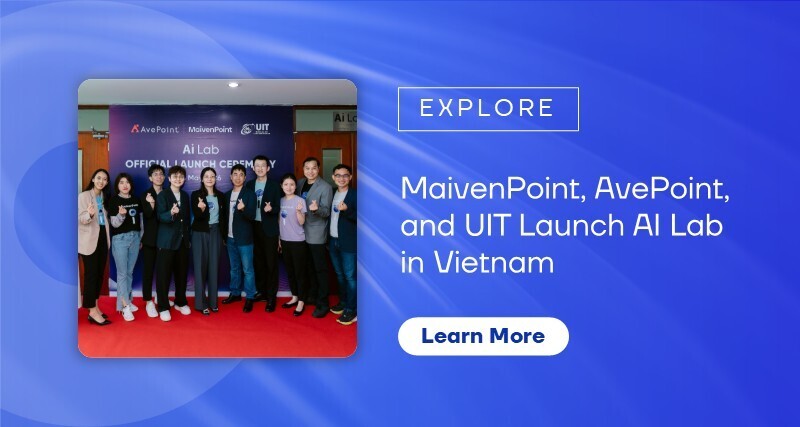
Similarly, the recently opened UIT–AvePoint AI Lab – a collaboration between MaivenPoint, AvePoint, and the University of Information Technology (UIT), Vietnam National University Ho Chi Minh City – enables students, researchers, and industry experts to collaborate on real-world technology challenges across AI and generative AI (GenAI), data science, cybersecurity, data governance, analytics, and digital transformation.
The AI Lab also provides opportunities for applied research, specialised training, internships, mentorship programmes, and access to advanced computing infrastructure aligned with international standards.
By giving students exposure to advanced technologies and practical business applications, the AI Lab strengthens the pipeline of future tech professionals while supporting Vietnam’s digital transformation ambitions. The workplace extends the learning journey, enabling participants to apply newly acquired skills while gaining valuable exposure to international standards, global collaboration practices, and emerging technologies.